
Conversational AI for Customer Service

In this digital age, companies have been required to provide immediate personalized customer service across various channels. This is where conversational AI for customer service is making changes and influencing how organizations serve their customers. With automated and intelligent human-like conversations, conversational artificial intelligence revolutionizes customer experience.
Today’s consumers are less interested in long queue waiting and difficult customer support systems. Rather, they need to get quick help through chat, voice assistants, and messengers. This increasing need of consumers has driven the emergence of conversational AI customer service.
Top players of conversational AI are using innovative technologies including natural language processing, machine learning, and voice recognition to develop intelligent systems that can understand and respond to customer needs at the same moment. Conversational artificial intelligence solutions differ from usual automatic solutions because they learn and improve over time.
From dealing with routine questions to assisting with purchases and providing personalized advice, there are plenty of examples of conversational artificial intelligence in the sectors such as banking, healthcare, e-commerce, and telecommunication.
Table of Contents
ToggleWhat Is Conversational AI for Customer Service
Customer Service Conversational AI, on the other hand, entails the deployment of artificial intelligence solutions to interact with customers in a conversational way either via text or voice. As opposed to conventional rule-based systems, conversational AI can comprehend the context, intentions, and language intricacies of communication.
The concept of conversational artificial intelligence entails the integration of natural language processing, machine learning, and automation techniques to make it possible for machines to converse naturally.
In the customer service context, conversational artificial intelligence is deployed mainly in chatbots, virtual assistants, and voice-enabled solutions. The technology can perform diverse activities including answering questions, providing assistance in completing procedures, booking appointments, and resolving issues among others.
Another significant benefit of using conversational AI customer support is the fact that it functions 24/7. Unlike traditional support, which involves people working in shifts and cannot ensure constant contact with clients, conversational AI does not require breaks and can work round-the-clock.
In the era of business digital transformation, conversational AI becomes an inevitable part of customer support services.
4 Reasons Conversational AI Matters Now
Rapid development of digital technologies and evolving customer expectations have contributed to the growing importance of conversational AI in providing customer support. Companies compete not just by offering products or better prices, but through customer experience that is better and faster. Below are four major reasons for the growth of conversational artificial intelligence.
1. Rising Customer Expectations
In today’s market environment, customers expect quick responses and personal attention. Delayed responses or waiting for calls to be answered may affect customer satisfaction. Customer services through conversational artificial intelligence can help companies to reply to their customers instantly.
2. Need for 24/7 Customer Support
Companies now operate in an international setting where customers can require help anytime. Maintaining human employees who provide round-the-clock assistance may prove to be costly and inefficient. Conversational AI becomes very important in such a case because of the round-the-clock availability of customer service.
3. Cost Reduction and Operational Efficiency
Cost optimization is one of the most significant benefits associated with using innovative solutions offered by the top conversational artificial intelligence firms. An AI solution is capable of dealing with a vast number of recurring inquiries, which significantly lessens the burden of human representatives.
4. Scalability and Business Growth
As organizations expand, there is an increased number of customer inquiries. The conventional support system may be inefficient in scaling up. Using conversational AI, it is possible to manage thousands of conversations concurrently without sacrificing efficiency. There are numerous examples of conversational AI that demonstrate how easy scaling up is for organizations during busy periods.
How Conversational AI Technology Works
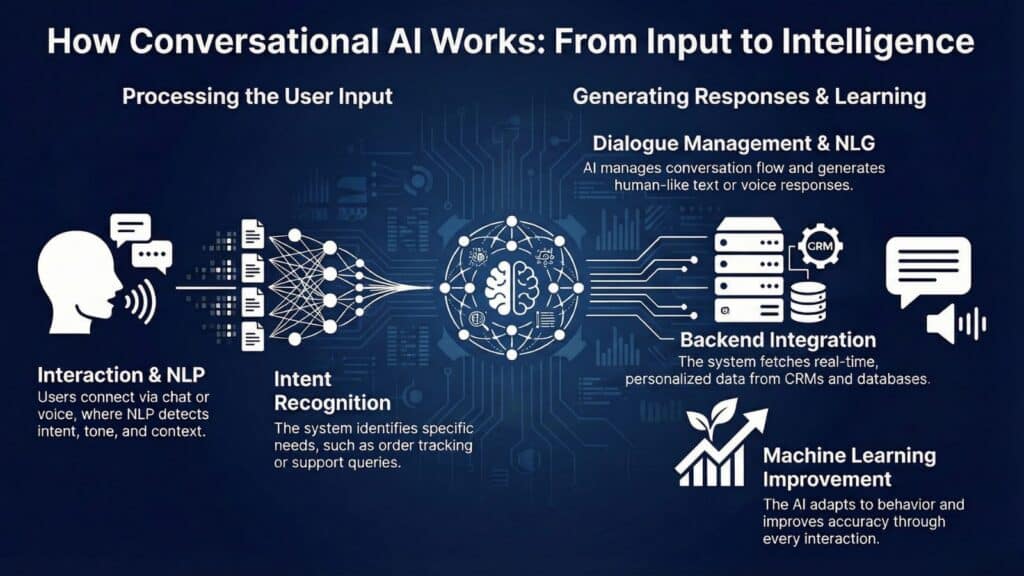
Conversational AI in customer service functions via natural language processing of user inputs to comprehend the query, understand the intent behind it, and reply in a human-like manner. It keeps improving via machine learning algorithms and is seamlessly integrated with back-end systems.
Rule-Based Chatbots vs Conversational AI
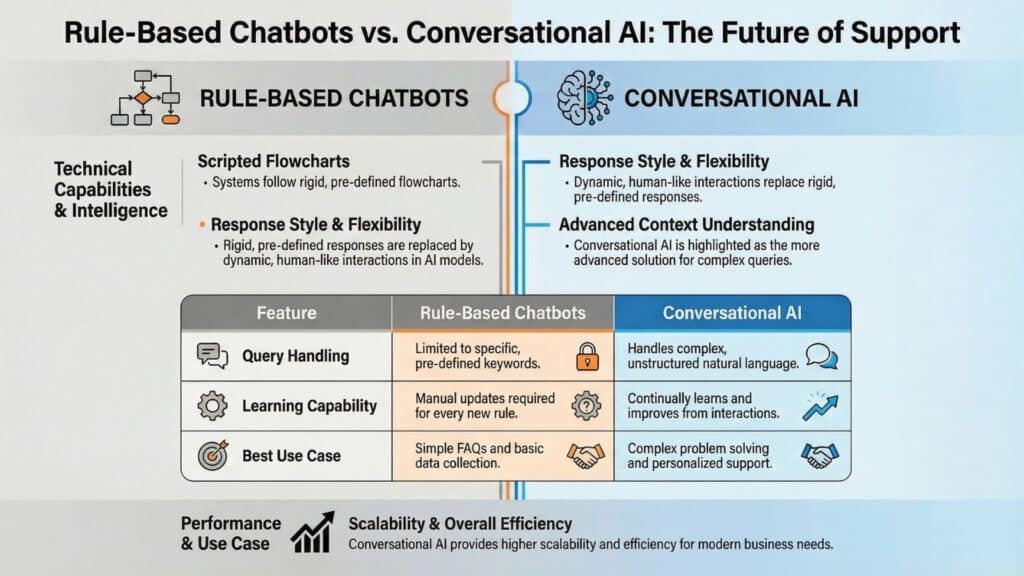
Organizations looking at automation may discover that there are two main tools that are quite popular: rule-based chatbots and conversational AI for customer service. Even though they serve similar functions, their difference is quite large.
Why Conversational AI Matters for Customer Service Now
In today’s world where everything goes digital first, the necessity of conversational AI for customer service has gained great momentum. Companies need to respond quickly, offer personalization, and provide multichannel support. That is one of the biggest reasons that led to the relevance of conversational artificial intelligence in the modern customer service field.
Firstly, customers are becoming impatient; they want immediate solutions. In the case of conversational AI customer service, it is easy to deliver immediate assistance using the latest technologies such as chatbots, virtual assistants, and voice-enabled solutions.
Secondly, the number of interactions with customers is growing. For instance, when a company starts to grow and gets lots of inquiries from people, it is impossible to work with them all manually. That is why there are solutions from leading companies offering conversational AI.
The cost savings factor is yet another significant motivator. Having a large team of customer support professionals is rather costly, especially if it is for 24/7 support. Conversational artificial intelligence helps lower costs by automating repetitive tasks without sacrificing quality and accuracy of answers. Many conversational AI examples prove that businesses managed not only to save money but also raise customer satisfaction rates.
Moreover, due to the emergence of omnichannel communication, it has become necessary for businesses to provide customer support across various channels including websites, mobile applications, social media and voice assistants. And conversational artificial intelligence helps them accomplish this goal.
Adopting solutions provided by top conversational AI companies gives businesses an edge because of faster, smarter and more personalized customer support services they offer. With conversational artificial intelligence, businesses get an essential competitive advantage in today’s market environment.
How Conversational AI Transforms Customer Service
The use of conversational AI in customer service is transforming the way organizations engage their clients. While conversational AI used to be viewed as automation, it is now seen as a tool for offering smarter and quicker experiences that can also be personalized on a much larger scale than before. With conversational AI customer service, businesses can shift from reacting to engaging their clients and doing it intelligently.
One of the key transformations caused by conversational AI is instant response capability. With the help of conversational AI customer service, companies will be able to offer assistance to their clients right away without delay. Customers will get responses either via chat or through voice and thus will enjoy better experiences and build trust.
Another important transformation is related to the ability to personalize customer service experiences. Conversational AI allows analyzing customer data and previous interactions to offer responses tailored to each particular case. Personalization has always been hard to implement with the help of traditional systems. Lots of conversational AI examples prove it.
Efficiency and productivity also improve significantly. By automating repetitive tasks such as answering FAQs, booking appointments, and tracking orders, conversational AI reduces the workload on human agents. This allows support teams to focus on more complex issues that require human expertise. Leading conversational AI companies are helping businesses streamline operations and improve agent performance.
Consistency in customer experience is another significant transformation. In contrast to human agents who may differ in reactions, conversational AI gives the same accurate information regardless of any contact. Consistency is critical when it comes to building brand reliability and trust.
Scalability is one more significant benefit that comes with the use of conversational artificial intelligence. In case of the increased number of customers’ requests, conversational AI systems are able to manage several interactions at once without losing in performance. Companies working with the best conversational AI companies have an opportunity to scale their customer service during sales campaigns or new product launches.
The last advantage that should be mentioned is proactive engagement. Thanks to conversational AI technology, businesses have an opportunity to initiate communication, send reminders, updates, and assistance depending on users’ actions.
How Conversational AI Works Across Voice and Chat
The contemporary business organizations have to communicate with customers via different channels of communication. In such a case, conversational AI for customer service becomes the most valuable solution. It allows making seamless conversations via voice and chat channels, which means that the customers will be provided with appropriate assistance via any chosen channel.
The conversational artificial intelligence technology is supposed to work through various channels like websites, mobile applications, messaging services, and voice assistants. Regardless of the fact whether the customer asks the question via a written form in chat or through voice requests, the technology works in the same manner, i.e., analyzes the intent and context of the message and provides an answer.
When it comes to conversation via chats, the conversational AI customer service technologies process the questions via natural language processing technology. The systems can process all kinds of questions – from FAQ questions to complex troubleshooting ones and provide immediate answers to customers. The examples of conversational AI chatbots include helping customers track their orders, manage their accounts, etc.
Regarding the voice part, conversational AI is connected with speech recognition and voice synthesis technologies. The systems can perceive human speech and provide the answer accordingly, thus creating a more natural conversation. There are companies engaged in development of voice technologies among conversational AI companies, which can help with handling customer queries, making routing of calls, as well as providing issue resolution without any human participation.
The most significant benefit of using conversational AI in both voice and chat is its consistency, since customers receive the same service and correct information through different channels.
Moreover, if the company cooperates with one of the conversational AI companies, it will be able to connect their system with different backend technologies, including CRM software and databases.
Voice AI and Voice Assistants
Voice technology is a critical element of conversational AI customer service that helps organizations engage their customers in quick, natural, and hands-free conversations. Conversational AI technology enables computers to understand speech, analyze it correctly, and react like a person to make customer service convenient and effective.
The heart of conversational artificial intelligence in voice technologies is the speech recognition technique that transforms the words of customers into texts. It is followed by natural language processing, which analyzes the intention of the client. Then, once the intention is known, the computer produces an answer and speaks it out using text-to-speech technology.
Voice assistants based on conversational AI customer service solutions are used in various customer contact centers. These assistants help people perform different functions, including answering customer questions, routing calls, providing clients with information about their accounts, and solving some of their problems without the assistance of people.
Numerous conversational AI cases show the application of voice AI in practical use cases for various business sectors. Telecom companies utilize voice AI for dealing with billing issues, whereas healthcare organizations do so for scheduling appointments and sending out reminders. The mentioned cases illustrate the increased significance of voice-based interaction.
The leading conversational AI companies are always striving to upgrade the voice AI technology through the improvement of accuracy, language comprehension, and personalization. Today’s voice technology allows recognizing diverse accents, adapting to customers’ preferences, and keeping the conversation context.
The next huge benefit of the voice AI technology is round-the-clock availability. The voice AI system is capable of processing customer calls at any time of day or night. Business collaboration with conversational AI companies allows scaling up the voice-based support services.
Text, Chat, and Digital Channels
Text communication is an integral element of conversational AI for customer service, allowing companies to communicate with customers via websites, applications, messaging services, and social networks. Conversational artificial intelligence understands users’ text questions through natural language processing, and provides informative and human-like answers to improve efficiency and convenience of the communication.
Conversational AI customer service solutions allow bots to perform various functions from answering the most frequent questions and help customers choose products to tracking orders and solving problems. This technology allows providing instant answers, saving customers’ time and increasing their satisfaction. Many examples of conversational AI show how companies use chat-based artificial intelligence to engage customers and increase efficiency of support services.
The most advanced conversational AI companies develop intelligent chat services, which analyze customers’ behavior and previous communication with the company and provide personalized interaction and context-maintenance conversations. The use of solutions developed by leading conversational AI companies ensures continuous availability and consistency of support service in all channels.
Voice AI vs Chat AI: How They Work Together
Both voice and chat are indispensable parts of conversational AI technology used in customer service because their combination provides an excellent support solution. Though voice AI deals with conversations made via speech and chat AI works with text messages, both use the technology of conversational artificial intelligence in order to provide an intelligent response.
Voice AI can be helpful in the cases when customers want to make a call to the support center or use voice assistants, while chat AI is usually used on websites and mobile applications and messenger services in cases when users want to send a message. Both channels work together providing convenience in terms of choice.
As for the conversational AI customer service, both the voice and the chat systems use the same backend technology, including natural language processing, intent recognition, and integration with data. It means that customers get the same quality of the responses, regardless of the channel of communication. There are many examples of conversational AI where customers can change channels of communication without losing the context of the conversation.
Leading conversational AI companies are enabling this integration by building unified platforms that support both voice and chat interactions. This allows businesses to deliver a connected and personalized experience across all touchpoints. By adopting solutions from top conversational AI companies, organizations can ensure smooth transitions between channels and improve overall customer satisfaction.
Omnichannel Orchestration
Orchestration of the omnichannel is one of the important factors of conversational artificial intelligence as customer services because the latter provides a unique way to deliver a seamless experience to clients throughout the interaction across all their touchpoints. In the modern digital world, customers communicate with companies using multiple channels including websites, mobile applications, social networks, messaging, and voice assistants. Conversational artificial intelligence makes sure that all these communications are interconnected and aligned regardless of the used channel.
The implementation of conversational AI into customer service allows managing and aligning conversations across various platforms in real time. This means that if a client starts communication through a chat, continues it through an email or messaging, and then changes the mode of communication to voice calls, this does not affect the quality and the content of the communication at all.
There are many examples of the use of conversational AI in business to make sure that the company engages with the clients using omnichannel strategy. For example, e-commerce companies use AI to analyze customer journeys across different channels, and service providers provide the same level of customer service in chat and voice modes.
Leading conversational AI companies are developing advanced orchestration platforms that centralize communication and provide a single view of customer interactions. This allows businesses to deliver personalized and context-aware responses at every stage of the customer journey. By choosing solutions from top conversational AI companies, organizations can ensure scalability, consistency, and a superior customer experience.
How Conversational AI Processes a Customer Query
Understanding how conversational AI for customer service processes a customer query helps businesses see how efficiently it delivers accurate and real-time responses. Conversational artificial intelligence follows a structured flow that transforms user input into meaningful and context-aware interactions.
The process begins when a customer submits a query through chat or voice. The system first uses natural language processing to understand the input, including the words, intent, and context behind the message. This allows conversational AI customer service systems to interpret different variations of the same question effectively.
Now, once the input has been recognized, there is a process of intent recognition in which the AI tries to understand the intent of the customer. For instance, an inquiry related to order status, billing, or technical support will be identified. There are many examples of conversational AI where you would see how accurate intent recognition is crucial for getting faster and relevant responses.
Next comes the stage of dialogue management wherein based on the intent identified earlier, the system decides what would be the most relevant response. In other words, the system might use databases or other back-end systems or even predefined workflow processes for doing this. However, the best conversational AI solutions help companies make sure their responses are accurate as well as contextual.
Finally, it is time to generate and provide responses in a natural way using the text and voice technologies. This is what makes conversational artificial intelligence so special and useful for businesses.
Using solutions offered by the leading conversational AI companies, enterprises could automate the process of query handling.
Key Conversational AI Tools and Capabilities
In order to offer a functional and efficient conversational AI customer service solution, there should be a number of tools used. These tools and capabilities help the technology interact with users efficiently.
Firstly, one of the main capabilities used by conversational AI systems includes natural language processing (NLP). It is what enables the systems to understand the meaning of users’ queries.
Secondly, machine learning (ML) is another tool that conversational AI uses. With the help of machine learning, the system becomes able to learn from previous experience and become better over time. Most conversational AI examples show how efficient the technologies become due to increased efficiency and accuracy after learning from past experience.
Another crucial technology that helps generate human-like replies is Natural Language Generation (NLG). The importance of this tool consists in making interactions feel natural instead of robotic. Major conversational artificial intelligence providers concentrate on improving NLG.
Speech recognition and text-to-speech technologies are extremely important when it comes to voice interaction of artificial intelligence with customers. These technologies make it possible for conversational AI to recognize spoken language and give voice responses.
One of the important capabilities of conversational artificial intelligence technology is integration with backend systems such as CRM systems, databases, and API’s. It means that AI can use real-time information to make its interactions more personalized and perform certain actions such as tracking orders and updating personal accounts.
Analytics and reports also help companies evaluate performance of their AI and improve it.
The Conversational AI Technology Stack
The effectiveness of conversational AI for customer service depends on a well-structured technology stack that brings together multiple components to enable intelligent and seamless interactions. Conversational artificial intelligence is not a single tool but a combination of integrated technologies that work together to understand, process, and respond to customer queries efficiently.
At the foundation of the stack is data collection and integration, where customer data is gathered from various sources such as websites, mobile apps, CRM systems, and databases. This data provides the context needed for conversational AI customer service systems to deliver personalized and relevant responses.
The next layer includes Natural Language Processing (NLP) and Machine Learning (ML) models. These components help the system understand user intent, analyze language patterns, and continuously improve performance. Many conversational AI examples demonstrate how these technologies enable accurate and context-aware communication.
Above this is the dialogue management layer, which controls the flow of conversations. It determines how the system responds based on user input, context, and predefined business logic. Leading conversational AI companies design this layer to ensure smooth and human-like interactions.
The application and integration layer connects the AI system with backend tools such as CRM platforms, helpdesk systems, and APIs. This allows the system to retrieve real-time information, execute tasks, and provide end-to-end support to customers.
Finally, the interface layer includes channels such as chatbots, mobile apps, websites, and voice assistants where users interact with the system. Solutions from top conversational AI companies ensure that these interfaces deliver a consistent experience across all touchpoints.
How to Implement Conversational AI in Your Contact Center
Implementing conversational AI for customer service in your contact center requires a strategic approach to ensure successful adoption and long-term value. Conversational artificial intelligence can significantly improve efficiency, customer satisfaction, and scalability, but it must be aligned with business goals and customer needs.
The first step is to identify key use cases where conversational AI customer service can deliver the most impact. This includes handling frequently asked questions, automating routine tasks, managing high-volume queries, and supporting customer journeys such as onboarding or order tracking. Many conversational AI examples show that starting with simple, high-impact use cases leads to faster success.
Next, businesses should choose the right platform from leading conversational AI companies. It is important to select a solution that offers strong natural language processing capabilities, easy integration with existing systems, and support for both chat and voice channels.
Another critical step is integration with backend systems such as CRM, helpdesk software, and databases. This allows conversational artificial intelligence to access real-time customer data and provide personalized, context-aware responses.
Businesses should also focus on designing effective conversation flows. This involves mapping customer journeys, defining intents, and creating responses that are clear, helpful, and natural. Proper conversation design ensures a smooth user experience and reduces friction.
Testing and optimization play a vital role in implementation. Before full deployment, the system should be tested with real-world scenarios to identify gaps and improve accuracy. Solutions from top conversational AI companies often include analytics tools to monitor performance and refine the system over time.
Finally, it is important to train and support human agents to work alongside AI systems. Conversational AI should complement human support, handling routine queries while agents focus on complex issues that require empathy and expertise.
6-Phase Conversational AI Roadmap
Implementing conversational AI for customer service is most effective when approached through a structured roadmap. A phased strategy helps businesses gradually adopt conversational artificial intelligence, minimize risks, and maximize long-term value. Here is a practical 6-phase roadmap to guide successful implementation.
The first phase is discovery and planning, where businesses identify goals, define use cases, and understand customer needs. This step ensures that conversational AI customer service aligns with business objectives and delivers measurable outcomes.
The second phase is design and strategy, which involves mapping customer journeys, defining intents, and creating conversation flows. Many conversational AI examples show that well-designed interactions significantly improve user experience and engagement.
The third phase focuses on development and integration. In this stage, the AI system is built and integrated with backend tools such as CRM systems, databases, and APIs. Leading conversational AI companies provide flexible platforms that simplify integration and accelerate deployment.
The fourth phase is testing and training, where the system is tested with real-world scenarios to ensure accuracy and reliability. Conversational artificial intelligence is trained using data to improve intent recognition and response quality.
The fifth phase is deployment and monitoring. Once the system goes live, businesses must monitor performance, track key metrics, and gather user feedback. Solutions from top conversational AI companies offer analytics tools to measure success and identify areas for improvement.
The final phase is optimization and scaling. Based on insights and performance data, businesses can refine the system, add new use cases, and expand across channels. This ensures continuous improvement and scalability.
What Does the Future Look Like
The future of conversational AI for customer service is set to be more intelligent, personalized, and deeply integrated into everyday business operations. As technology continues to evolve, conversational artificial intelligence will move beyond basic automation to deliver highly contextual and human-like interactions that closely mimic real conversations.
One of the key trends shaping the future is hyper-personalization. Advanced conversational AI customer service systems will leverage real-time data, customer behavior, and predictive analytics to provide tailored responses and recommendations. This will enable businesses to anticipate customer needs and offer proactive support rather than reactive solutions.
Another major development is the rise of multilingual and global support. Future systems from leading conversational AI companies will seamlessly handle multiple languages and regional nuances, allowing businesses to serve diverse customer bases without additional resources. This will be especially valuable for companies expanding into international markets.
Voice technology will also continue to advance, making interactions more natural and intuitive. Many conversational AI examples already show improvements in voice recognition, emotion detection, and contextual understanding. These advancements will make voice assistants more accurate and capable of handling complex customer interactions.
Integration will become even more powerful, with conversational artificial intelligence connecting deeply with enterprise systems such as CRM, analytics platforms, and business intelligence tools. Solutions from top conversational AI companies will offer unified ecosystems that provide a complete view of customer interactions across all channels.
Additionally, AI will play a bigger role in augmenting human agents rather than replacing them. It will assist agents with real-time suggestions, automate repetitive tasks, and provide insights that improve decision-making and productivity.
The Bottom Line
Conversational AI for customer service is no longer a future concept—it is a present-day necessity for businesses aiming to deliver fast, efficient, and personalized customer experiences. As customer expectations continue to evolve, conversational artificial intelligence provides the tools needed to meet these demands at scale.
By leveraging conversational AI customer service, organizations can automate routine interactions, reduce response times, and improve overall operational efficiency. From chatbots to voice assistants, there are numerous conversational AI examples that demonstrate how businesses are transforming their support systems to be more responsive and intelligent.
Partnering with leading conversational AI companies allows businesses to access advanced technologies such as natural language processing, machine learning, and omnichannel integration. These capabilities help create seamless customer journeys and ensure consistent communication across all platforms. Choosing solutions from top conversational AI companies further enables scalability, reliability, and long-term growth.
Ultimately, conversational artificial intelligence empowers businesses to move beyond traditional customer support models and adopt a more proactive, data-driven approach. It enhances both customer satisfaction and business performance, making it a critical investment in today’s competitive landscape.
Frequently Asked Questions
What is the difference between conversational AI and a chatbot
A chatbot is a basic tool that follows predefined rules and scripts, while conversational AI for customer service uses advanced technologies like natural language processing and machine learning to understand context, intent, and deliver human-like responses. Conversational artificial intelligence is more flexible, intelligent, and capable of handling complex interactions compared to traditional chatbots.
What are the risks of using conversational AI in customer service
While conversational AI customer service offers many benefits, there are some risks such as inaccurate responses, lack of human touch in sensitive situations, and data privacy concerns. However, these risks can be minimized by choosing reliable solutions from leading conversational AI companies and continuously monitoring system performance.
How does conversational AI handle multiple languages
Conversational artificial intelligence uses multilingual natural language processing models to understand and respond in different languages. Many top conversational AI companies offer solutions that support multiple languages and regional variations, enabling businesses to provide global customer support efficiently.
What are the benefits of conversational AI for customer service
The key benefits of conversational AI for customer service include faster response times, 24/7 availability, cost reduction, scalability, and improved customer satisfaction. Many conversational AI examples show how businesses enhance engagement and streamline support operations using AI-driven solutions.
How does conversational AI work in customer service
Conversational AI customer service works by analyzing customer input using natural language processing, identifying intent, and generating relevant responses. It integrates with backend systems to provide real-time information and continuously improves through machine learning.
Types of conversational AI for customer service
There are several types of conversational artificial intelligence used in customer service, including chatbots, voice assistants, virtual agents, and AI-powered messaging systems. Leading conversational AI companies offer these solutions across multiple channels such as web, mobile, and voice platforms.
Conversational AI use cases and examples for customer service
There are many practical conversational AI examples across industries. In e-commerce, AI assists with product recommendations and order tracking. In banking, it helps with transactions and account inquiries. In healthcare, it supports appointment scheduling and patient engagement. Businesses working with top conversational AI companies are leveraging these use cases to improve efficiency and customer experience.